


This dark fairy tale is part of the Substack event Spring Fever! Horror in Bloom, stories designed to give the season its spooky due.
There is a town with no hope.
One might say it’s hopeless. But that’s not quite right. The town, in fact, is capable of producing pockets of optimism, tiny specimens of aspirations and dreams. However, these are actively snuffed out as soon as they’re spotted.
The effect is subtle but startling once recognized, and no one can say just what causes it. It could be a collective illusion or some lingering curse with origins in the long-ago past. Those who dare whisper of a sort of shroud sloughed off the back of an ancient god of sadness that fell upon the town, never to be retrieved.
Whatever the cause, the effects are widespread and deep-reaching.
For instance, the sky is always a shade of grey even when it’s a late summer afternoon, the azure canopy clouded by an ashen pearl cataract. When the sunset marbles the sky pink and gold, a sooty fog obscures the brilliance. Maybe the only thing that defies the dimming is the moon, its light already a cold mirror of day.
Living things exist here but they do not thrive.
Children are pale and often sick. Their adult counterparts seem to bear up against invisible loads, faces twisted into permanent grimaces under the weight.
Miserable dogs, coats and eyes dull, sit and stay, loyal to a fault. All the cats have long since run away or have sharpened their claws and teeth, depending on their dispositions. Occasionally a crow will swoop in, rough voice calling out uncertain tidings. But birds are inherently hopeful, and so they don’t last long.
Vegetation is limited to blackberry vines—which have their own way of spreading despair—and lacy lichens that could almost be beautiful until you realize they’re smothering every surface, tiny roots pushing through dead wood and hard stone with equal quiet violence.
There are no trees; for what is the cycle of a leaf but a signal of renewal? What is the strange spectacle of evergreen needles but a suggestion of life eternal?
There are only the skeleton snags of long-dead arbors, signs of a different life lived once upon a time, allowed to stand as warnings to those who might wish for something more.
But trees, even long-dead ones, have a kind of magic. They harbor life, become nurseries for new generations. Ants and beetles, spiders and worms, make a home in the broken bark, rich and moist and secretly fertile.
It was in this strange, furtive way that the cherry tree came to be.
A seed dropped by one of those occasional crows, nurtured by dead things, sheltered from the town’s gaze by anthracite trunks, the cherry tree grew against improbable odds. Seven times the tree’s green leaves found the grey sunlight. Seven times they fell, crinkled and brown, cradled in a lichen embrace.
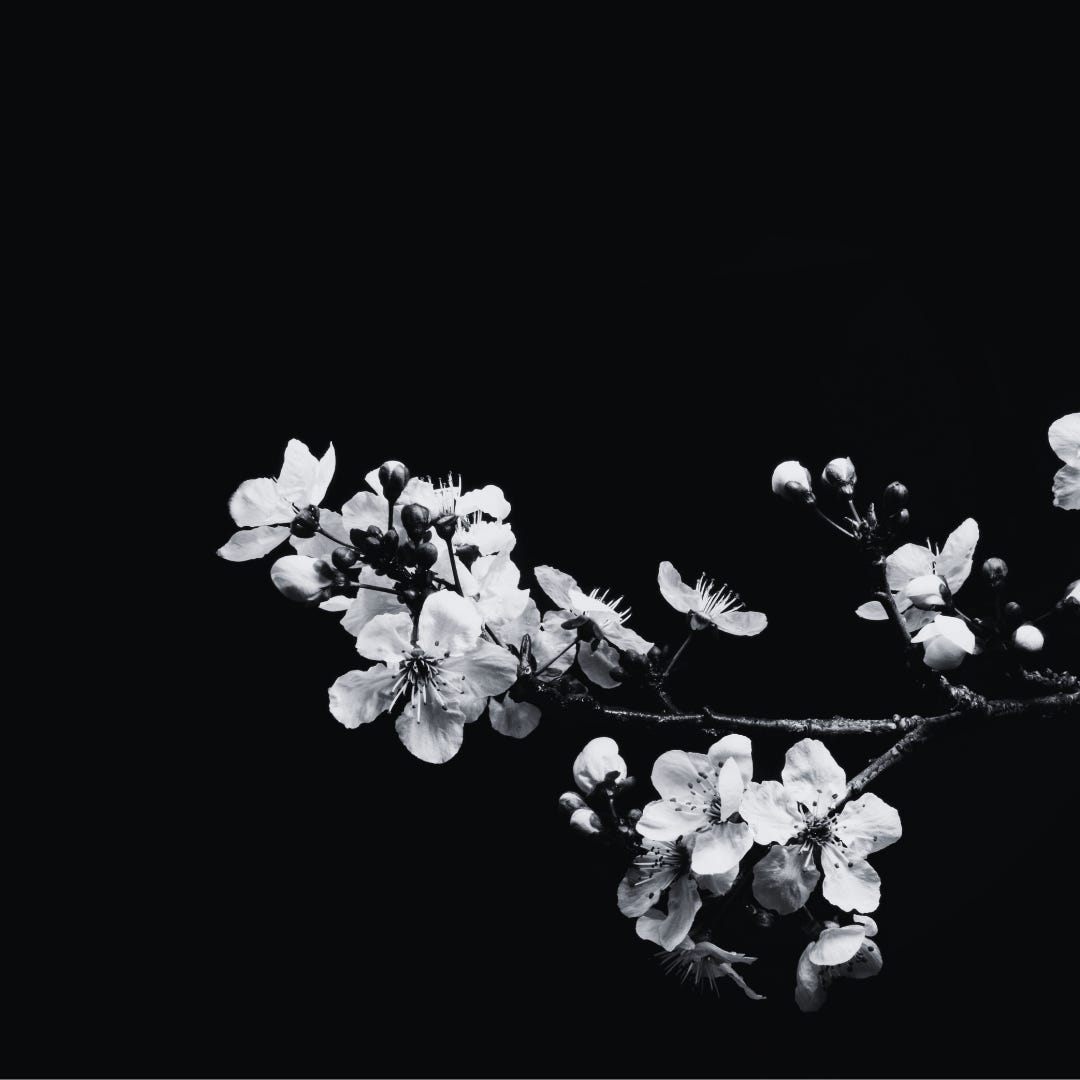
And then one early spring, something different happened. Behind its protective screen of snapped-bone branches, the cherry tree did not grow leaves but flowers.
The blooms were beautiful, delicate little stars of brightness in the grey landscape. And the young tree felt the change. There was a new vitality that pulsed in its sap, that yearned for connection. The tree felt restless. It felt needful.
It waited a day, two, three, until finally the feeling reverberated from bark to heartwood. The flowers itched and strained, wanting something that the tree alone could not provide, that the nurturing snags and weather-blackened branches and lichen-covered ground could not offer.
So under the silver-grey light of a crescent moon, the flowers slipped from their branches, not falling down so much as falling together. And they made themselves into the shape of a creature. It was the kind of shape the tree had seen for seven cycles now and the flowers knew it well.
The flower creature had six legs and two antennae, a small forebody, narrow middle, and large abdomen. It scuttled away from its nursery, soft and graceful and impossibly delicate.
When the flowers emerged from the edge of the dead tree forest, the streets of the town were silent, the windows of the houses empty sockets. The flowers lifted their head, tasted the air, and searched for fulfillment, partnership, something that would make them feel whole.
They were frozen in the middle of the asphalt on the only road out of town, waiting, hoping for something to ease the longing that peeled back their sepals and made their stamen dance and ache. The people of the town turned as one in their sleep, their closed eyes watching. The town itself, cloaked in misery, held its breath.
A gentle breeze ruffled the flower creature’s antennae, and they caught, just for a moment, something on the wind. An answer to their needfulness.
Moments later a swath of yellow light swung around the corner and across the cherry blossoms. Wheels screeched and skidded on the damp pavement, and a car crashed through the flower creature, the blossoms exploding into a shower of petals.
Metal screamed. Glass shattered. The air no longer smelled promising. Instead, it was heavy with smoke, burnt rubber, fear.
Slowly, the flowers eased back together. They fluffed their crumpled petals, shook out their stamens. Then, together, they took two shuddering steps forward on their dainty legs.
The car was wrapped around a light pole. One tire still spun in wobbly circles on its broken axel. A slick of something dark oozed onto the street. The flower creature crept closer. Someone lay on the shattered glass of the windshield, their crushed cheek pressed to the hood, their mangled body twisted together with the remains of the driver’s seat. They lay still, like the ants who fell on their way back to the nest.
The flower creature thought about carrying it away, like the ants did with their own, but they couldn’t be sure where to take it. Instead, they slunk as close as they dared and they lifted their stamens to taste the air, wondering, hoping that this might be the origin of the scent they caught on the breeze moments before the crash.
And there was something in the aftermath. Something in the destruction. The echo of wishes made and prayers thrown to senseless deities, a record of suppressed hope that bled out of the body alongside its life force. But it wasn’t what the flower creature needed.
It abandoned the dead one’s side as a wail went up in the distance, red and blue lights flashing through the night. Down the street it raced, spindle-legged, petals fluttering.
A mile or two away the flower creature stopped. So far there had been nothing more on the wind but the same sour fug that seemed to sit over the town, invisible but thick and pungent. But as the flowers passed the large unfenced yard of a sprawling house, they caught another scent on the air.
It was edged with that same smell from the accident, the one that wafted from the dead one in wisps that disappeared in the breeze. But at the heart of it was something gamey, something wilder, and it made the flowers tremble.
Just there, ahead in the wet grass, was a flash in the darkness. A rangy rabbit bounded away, another close behind. The flower creature darted forward, its six legs plucking out a path through the dew-dappled blades.
First one rabbit, then the other, disappeared down the mouth of a dark hole in the earth, setting the blackberry vines that guarded the entrance bouncing. The flower creature stopped its pursuit and reached out a tentative leg. The blossoms at the end of it extended their pistils. The scent inside the burrow was rich, tantalizing. Needful in a way that felt familiar to the flowers.
The creature pressed itself inside the narrow entrance, even as the blackberry vines tore some of the flowers to shreds and the rocky ground covered the sensitive stamen with choking dust.
It crammed itself into the hole, body structure collapsing so that it became sinuous and wormlike. The flowers followed the urgent scent of the rabbits through the tunnel as it twisted into the ground.
Ahead, in a small burrow warmed by body heat, one rabbit pressed against the other, their patchy furs mingling, their tiny bodies thrumming.
The flowers could sense the needfulness here. They reached for it even as they understood it to be just a shade of the thing they craved. Closer the creature came until the petal of one flower brushed the foot of the first rabbit.
The response was immediate and disastrous. The rabbit thrust itself away from its partner, black eyes wide, and attempted to escape the same way it had come. But the tunnel was narrow and the flowers now filled the entirety of the exit.
Finding its path blocked, the rabbit scrambled back and lashed out, raking its powerful hind feet through the blossoms and spilling them out across the burrow floor. It struck again and again, tearing at the flower creature but making no real headway.
The first rabbit’s frantic movements startled the second, sending it into a panic. It, too, defended itself with bites, swift kicks, and sharp nails, but instead of the flowers, it tore at its mate until the first was forced to retaliate.
The flower creature retreated, trailing torn petals and fallen stamen in its wake.
Out of the ground and back in the cold night, the flowers stood once more on six legs. From the hole drifted only the smell of death, whatever wild need that once beckoned lost amid the tang of salt and iron.
The flower creature slunk away on heavy legs.
The dead one in the car. Now the rabbits in their burrow. They were not deaths the flowers had seen before, like the fallen insects or the way the flowers’ own tree shed its shriveled leaves each year. Those deaths had the scent of inevitability. In the car and the burrow, the creature smelled guilt, an emotion it could feel but not name.
The flowers, wilting under the weight of consequence, turned away from the hole and began to retrace their steps back to the safety of the snags and the lichen.
The people in their dreamless sleep turned away. The town, smug with victory, sighed, and the wind blew stale.
But just as the flowers were leaving the road, at the edge of the asphalt, they smelled something sweet and wonderful that cut through the town’s fetid breath. The smell shifted the weight of guilt, and breathed life into the heart of each bloom. And they knew this was what they had come for. The answer to their need.
The petals shuddered and pulsed and together they ran to the far side of town and a small house with a single window lit up orange in the night.
The window was up high, higher than some of the snags in the flowers’ home, but if they stretched as far as they could, body and legs elongating, they could just see in, antennae poking past the open window and curtains to glimpse a girl of fifteen.
The girl was awake, unusual in a town where sleep was often the only respite from a hope-starved life. And she glowed. Not in any way that the others of her kind would have noticed, their vision limited to the monotonous now.
No, this was a glow that only the flowers could see. For the girl, like the tree, had grown hopeful despite the town’s worst intentions; had hidden her heart behind bruised ribs, had nourished her spirit in a cradle of whispered stories on the pages of forgotten books. And in each other they could sense a kindredness, an answer to their needfulness. Another like them.
The girl approached the creature, eager but tentative. She leaned out the window, reached out a finger, stroked one petal. Her glow danced along the petal’s serrated pink edge and settled on the tip of the stigma. In return the flower’s anthers stirred, pollen alighting on her skin. She brought her finger to her tongue, tasting the tree. Then she dipped her whole hand into the blossoms, stroking an antenna, searching, craving.
The blossoms all strained toward her, the bottom legs of their creature form crumpling as they thrust upwards. The girl strained toward the blossoms, her feet hardly touching her bedroom floor. And from one moment to the next, the balance shifted. The girl fell.
As the girl tumbled through the blossoms, the creature’s six-legged shape disintegrated, the flowers pushed out and away into a disorganized cloud. The air, once light and sweet, was tinged with the same acrid smell of lost chances and snuffed opportunities that permeated the car crash and the rabbit burrow.
The flower creature registered the change, and its petals shook, terrified. The town, eager to suppress the flowers and the girl, pulled the shroud of sadness tight. The pistils in the blossoms drooped. The girl’s scream caught in her throat. The town’s sleepers smiled but it did not reach their closed eyes.
But trees have a kind of magic in them. They are life givers, players in a cycle that speaks not to ends but to new beginnings. The flowers felt the echo of this in their verdant hearts.
They pulled themselves together, mimicking their own lichen cradle, and the girl came safely to rest on a pillow of lacy pink. The air shifted from terror-heavy to joy-light and the girl stretched herself across the blooms, her glow finding the deepest parts of them.
And the sleepers dreamed of mossy wood, or cool puddles, or tiny buds, or nestlings cheeping. And the town, crushed for a moment under the weight of spring dreams, lay still.
The girl wept, her tears luminescent in the moonlight. No longer needful, the flowers resumed their six-legged shape and, pressing a final soft touch to the girl’s hand, found their way back to the stand of snags, their nurse log, and their lichen bed. They lifted themselves to each wet, black bough and rested, fulfilled.
Weeks later, amid the trees deep jewel-green leaves, there appeared cherries. Perfect shiny red orbs that bounced in the breeze. A child, thin and wan, and banished from their house for some transgression invented by their dour-faced elders, happened upon the secret tree.
Mesmerized by the little red fruits, so colorful in contrast to the rest of the child’s drab world, they reached their tiny fingers into the leaves and plucked a cherry from its perch. They hesitated only a moment before popping it into their mouth.
A careful bite. The flesh popped and the tart juice danced on their tongue. The child spit out the seed, cradled it in the palm of their hand. On the ground by their feet the lichen looked soft. The child pushed the seed into its embrace, a pocket of potential in that terrible town.
The tree shivered and its leaves danced.
The child walked on, glowing.
Thank you for reading Blossom, my contribution to Spring Fever! Horror in Bloom. Many thanks to TiF Team for hosting this collection of lush laments and dew-dappled devilishness.
Want to read more? I’m Garen Marie. I write dark fantasy, strange romance, and atmospheric horror. I’ve saved you a seat at my witch’s table, where even the darkest stories are served up with heart. 🖤 Here’s a taste.
There’s something quietly devastating about this world you built…
the way hope isn’t absent, just systematically extinguished.
That line…
“Living things exist here but they do not thrive.”
really sets the tone for everything that follows.
And then the shift with the blossoms… that needfulness, that reaching…
the way beauty becomes something active, almost desperate…
it makes the ending land in such a complicated way. Not quite hope, not quite horror.
More like… persistence.
Really striking work.
strange and wonderful Garen. the flower creature is a fantastic bit of creativity. this reminds me of one of my favorite short story collections, a book called Fruiting Bodies by Kathryn Harlan